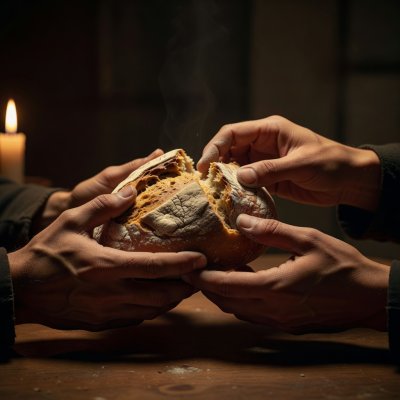
Of all the laws of life, cause and effect is the one we trust most and examine least. Drop a glass and it breaks. Skip sleep and the next day goes badly. Speak sharply to a colleague and the meeting changes temperature. We live inside chains of consequence so constantly that they become invisible.
The oldest law
Almost every intellectual tradition starts with causality. Aristotle described four kinds of cause in his Physics: what a thing is made of, its form, what set it in motion, and what it is for. Indian philosophy developed the idea of karma, literally "action", in which every deed carries consequences forward. In 1687 Isaac Newton's Principia gave causality its most famous mathematical form: forces produce accelerations, and every action meets an equal and opposite reaction.
Newton's third law is about physical bodies, not personal behaviour, and it is worth saying so plainly. Still, the cultural echo is understandable. His work showed that the world was not arbitrary. If you know the forces, you can predict the motion.
Every effect has a cause, but not every cause is the one we first suspect.
Working rule of this guide
Hume's doubt
In 1739 the Scottish philosopher David Hume, in A Treatise of Human Nature, pointed out something uncomfortable. We never actually see causation. We see one event followed by another, repeatedly, and our minds supply the connection. That does not mean causes are unreal; it means our confidence in particular causes is a habit of inference, and habits can mislead.
Modern statistics took Hume seriously. "Correlation is not causation" became a slogan, and in The Book of Why (2018) the computer scientist Judea Pearl, writing with Dana Mackenzie, set out formal tools for distinguishing genuine causes from coincidences and confounders. The lesson for daily life is modest but valuable: when you think you know why something happened, ask what else could explain it.
What is in our control
If everything has causes, where does that leave choice? The Stoic philosophers of Greece and Rome offered a practical answer that still holds up. Epictetus, a former slave who taught in Nicopolis, opened his Enchiridion by dividing the world into what is "up to us" (our judgements, intentions and actions) and what is not (other people, reputation, outcomes).
The Stoic view is that we are one cause among many. We can choose good inputs; we cannot dictate results. Marcus Aurelius returns to this again and again in his Meditations, written while he governed the Roman Empire during war and plague. The idea is not resignation. It is a way of putting effort where it actually has leverage.
Choose the cause carefully. Hold the outcome loosely.
A Stoic reading of causality
Using it in ordinary life
Thinking causally is a skill. Three habits help:
- Trace one step further. Before acting, ask "and then what?" at least twice. Most bad decisions look fine at the first step.
- Separate inputs from outcomes. Judge your week by what you did, not only by what happened. Outcomes include luck; inputs are yours.
- Look for delays. Many causes act slowly. Diet, trust and skill all show results months after the actions that created them.
In 1972 the meteorologist Edward Lorenz gave a talk asking whether the flap of a butterfly's wings in Brazil could set off a tornado in Texas. His point was about sensitivity in complex systems: tiny differences in starting conditions can produce very different results. Applied cautiously, this is a reminder that small acts are not automatically trivial.
Limits and misuses
The law of cause and effect is often stretched into a moral claim: that people always get what they deserve. That is a different idea, and a harmful one. Illness, accidents and injustice have causes, but those causes are frequently outside the sufferer's control. The psychologist Melvin Lerner called the tendency to assume otherwise the "just-world hypothesis", and documented how it leads people to blame victims.
A second limit is complexity. In tangled systems such as economies, ecosystems or families, causes interact and loop back on themselves. Single-cause stories feel satisfying and are usually incomplete. The honest version of this law is humbler: actions have consequences, many of them hidden or delayed, and we are responsible for our part, not the whole.
Read next: how repeated causes add up over time in the law of compounding.