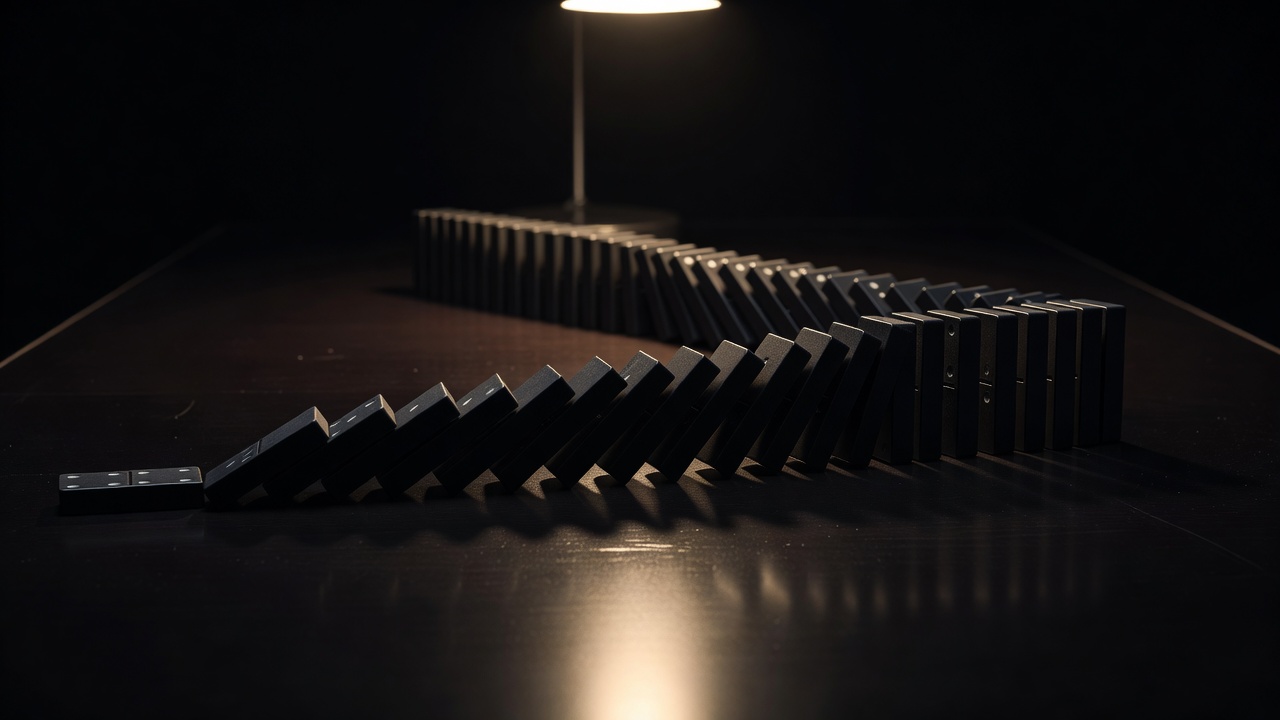
Everything you can point to is in the middle of changing. Your cells are being replaced, your opinions are drifting, the mountains outside your window are eroding at a rate too slow to see. Impermanence is the most obvious law of life and the one we resist hardest. We plan, build and love as if things will hold still.
The river
Around 500 BCE the Greek philosopher Heraclitus of Ephesus taught that the world is in constant flux. His most famous line survives only second-hand, through Plato's dialogue Cratylus: you cannot step twice into the same river. The water has moved on, and so, in a smaller way, have you.
Heraclitus did not think the world was chaos. He believed change follows a pattern, which he called the logos. A river keeps its shape precisely because its water keeps moving. Stability, in this view, is a kind of change that repeats.
No one steps into the same river twice.
Heraclitus, as reported by Plato
Anicca
At roughly the same time in northern India, the teaching attributed to Siddhartha Gautama, the Buddha, placed impermanence, anicca in the Pali language, among the three marks of existence alongside suffering and non-self. The core claim is psychological: much of our distress comes from clinging to things as though they were fixed.
One need not accept Buddhist doctrine to find this observation useful. Modern acceptance-based therapies, including Acceptance and Commitment Therapy developed by Steven C. Hayes in the 1980s, draw on a similar insight. Thoughts and feelings pass. Treating them as temporary weather rather than permanent climate tends to reduce their grip.

Entropy
Physics adds a harder edge. In 1865 the German physicist Rudolf Clausius introduced the term entropy and stated what became the second law of thermodynamics: in an isolated system, entropy tends to increase. Ordered states give way to disordered ones. Hot coffee cools, buildings decay, and organised structures need a constant input of energy to stay organised.
Living things are remarkable precisely because they resist this locally. In his 1944 lectures published as What Is Life?, Erwin Schrödinger described organisms as systems that maintain order by drawing energy from their surroundings. The everyday translation is blunt: anything you want to keep, from a garden to a friendship, needs maintenance.
Order is not a possession. It is a practice that has to be renewed.
Entropy, translated into daily life
Stoic acceptance
The Roman emperor Marcus Aurelius returned to impermanence constantly in his private notebook, the Meditations. He reminded himself that famous names were already forgotten and that loss is simply change, which nature is always making. The purpose was not gloom. It was to free attention for the present task.
Practical ways to apply the law:
- Enjoy without gripping. Knowing a good season will end can deepen, not spoil, the pleasure of it.
- Endure without despair. Bad periods are subject to the same law. "This too shall pass" is a statement about physics as much as comfort.
- Budget for maintenance. Schedule upkeep for health, relationships and work, because decay is the default.
- Hold identities lightly. The person you are now is a stage, not a finished product.
Limits
Impermanence can be misused as an excuse for detachment from responsibility: if nothing lasts, why bother? That reading misses the point of every tradition above. Heraclitus saw pattern in flux, the Buddha taught ethical conduct, and the Stoics were intensely committed to duty.
Some things also change slowly enough to treat as fixed for practical purposes. Physical constants, mathematical truths and deep human needs are stable on any timescale that matters to a single life. The wise use of this law is to distinguish what moves quickly from what moves slowly, and to build on the second. That stability is part of what makes reciprocity possible between people.